
Cahit Arf 1959
CAN A MACHINE THINK AND HOW CAN IT THINK?
Professor Ordinarius Dr. Cahit Arf
English edition
Originally published in Atatürk Üniversitesi, 1958-1959 Öğretim Yılı, Halk Konferansları I, Erzurum, 1959.
It was a great joy for me to be invited, as a mathematician, to give a lecture in the first academic year of Atatürk University in Erzurum, one of our country's oldest centers of culture. I would like to express my deep thanks to Atatürk University, which gave me this joy, and to its representative, the distinguished Rector Prof. Sabahattin Özbek, not because this is customary on visits of this kind, but because I truly feel it.
Before coming here, Erzurum was for me, as for many people, a legendary and somewhat imaginary city because of the heroism of its people, its history, and what those who had visited it told us. Let me add that since coming here, despite all its realities, Erzurum has not ceased to be an imaginary city for me. The reason may be that I see Erzurum as I would like it to be in the future.
I would like to see Erzurum acquire, in the modern sense, its character as a very old center of culture. The thirst for knowledge, which is the basic condition for this, was something I observed before coming here and have observed again since arriving. This idea has spread so completely through the atmosphere of Erzurum that it is felt everywhere, in every gesture and every look. This great desire will surely make real the dream that is mine and perhaps ours, and Erzurum will be filled with tens of thousands of local and foreign students and become known throughout the world for its laboratories and researchers. There is no reason why this should not happen. Very near Erzurum there is such an example, Tbilisi. If they can do it, why should we not? We have the intelligence and the health to do it. More importantly, the idealism that lies dormant in our large cities in the West, perhaps disappearing there or degenerating into little more than empty talk, still exists here, and perhaps the climate at an altitude of two thousand meters will keep it alive for many years.
This desire to learn and this idealism whose existence we observe are of course not enough to create a university. If we regard them as effective forces that give rise to a center of knowledge, then, just as in a mill driven by water power, channels are needed to carry these forces toward their goal. The purpose of this lecture is to speak about one of these channels that I consider important, the positive way of thinking.
In the past, among both our educated and uneducated people, more markedly among the educated, the following mentality prevailed: when we encountered a situation outside the events we were accustomed to, it was not customary to understand that situation with our common sense and arrange our conduct according to that understanding. What was customary was to consult someone whom we regarded as deeply learned, a teacher, ask his advice about how we should act, and then act accordingly. We almost trusted ourselves to understand the situation through our common sense and make our decisions accordingly. What we expected from the deeply learned teacher was not that he would help us exercise our common sense. Indeed, if he had tried to do such a thing, our confidence in his learning would have been shaken. What we expected from him, in support of his advice and explanations, was that he would cite the ancients.
We still encounter many remnants of this mentality today, though in a different guise. Discussions among our educated people often take the form of debates. The aim is not so much to understand the other person's idea or try to explain our own as to defeat the other person. One of the means used for this purpose is to cite deeply learned people, with the difference that today's deeply learned person is a Western scientist. Such a scientist may perhaps be a more reliable source than the medieval philosophers and religious figures on whom people once relied. But the point I wish to emphasize is our lack of confidence in our own common sense. The views of deeply learned people should of course be used, but they should be used to help us exercise our common sense, not as conclusions. Our own minds should reach the conclusion.
Another manifestation of the same mentality is our excessive confidence in Westerners and in what Westerners do. The German or the American has almost taken the place once occupied by the learned teacher.
In my view, whether our thirst for knowledge can find a path for itself depends on the spread of confidence in common sense. By this confidence I do not mean blindly admiring our own minds. It is more a kind of inability: being unable to accept or do anything without understanding it, being unable to learn without understanding, feeling more pain at not understanding than at not knowing, and sincerely trying to understand. To suggest what I mean by understanding, let me tell you something that caught my attention while I was doing my military service. At the Reserve Officer School there was a training battery. Soldiers operated this battery and showed the reserve officer candidates how the guns worked. Some of these soldiers had entered the army without knowing how to read or write. Despite this, they understood the operation of the different parts of the guns and the construction of the measuring instruments more correctly and more easily than some of the reserve officer candidates, all of whom were university graduates. I think the reason was this: the possibility of memorizing without understanding, which unfortunately still exists in our schools, had caused these reserve officer candidates to lose their ability to break down and analyze events that appeared new and complex into events we already knew and found simple. The soldier who had come from his village, on the other hand, had not lost this ability, which every human being naturally possesses. As a result of a faulty educational system, the university-educated reserve officer candidate could think with words that had lost their content, almost like the machines we shall discuss shortly, while the soldier thought not with words he did not know very well, but with the events themselves, which were closer to him.
This confidence in common sense, which I believe necessary, should in my view be general. The governor should think this way, the lawyer should think this way, the farrier should think this way, and our children should think this way. Only when we acquire such a habit will some of us be able to add new things to what we have learned.
Many of the events or arrangements that seem complex to us are not nearly as difficult to understand as we suppose. I shall give an example of this in this lecture. But I should first note one point. Understanding many events or arrangements can be compared to climbing a staircase. Climbing one step is easy, but climbing a thousand steps takes a good deal of sweat. In the same way, no diabolical intelligence of the kind we imagine in our subconscious to exist among Westerners is needed to understand the principles of the works produced by Western science and technology. Besides his confidence in common sense, the Westerner's second quality is the patience, determination, and persistence he shows in joining together the principles he has understood, that is, in climbing the steps of the staircase one by one. Our thirst for knowledge will give us this patience.
To show why we should not rush if we want to understand, truly understand, let me tell the following story. Marconi, who is regarded as the inventor of the first radio transmitter, is at a gathering in England. One of the ladies present asks him how wireless telegraph communication works. Marconi begins by explaining that when a stone is thrown into one side of a pool, the wave it produces spreads and allows someone at the other side to know that the stone was thrown, and that stones thrown into the pool at different intervals can send signals to the other side. But the impatient lady says, "Ah, I understand," and explains wireless telegraphy to her friends like this: to communicate by wireless telegraph between England and New York, stones are thrown into the Atlantic from the English coast, the waves they produce are recorded in New York, and these are then interpreted as words according to an agreed system. The English lady should have listened patiently to Marconi and understood that the pool mentioned was a pool of space called ether,1 and that the stones were electrical impulses emitted from the antenna into this space. But this would have cost her an hour or two of concentrated attention.
Now let us turn to an example of how things we suppose difficult to understand can be understood with a little attention and a little knowledge. After the Second World War, newspapers and radio spoke, and continue to speak, of three miracles created by science. These are the production of atomic energy, thinking machines that make decisions according to circumstances and carry out actions appropriate to those decisions, in other words electronic brains, and finally devices launched into space, that is, artificial satellites. The impression we get from newspapers, radio, and magazines is that these are incomprehensible things, that only Americans, Englishmen, and Germans can understand and make them, and that all that remains for us is to say in amazement, "what things there are."
Let us take the second example, thinking machines, and see that this is not at all the case.
We might say that the tangible, visible manifestation of thought is that different inputs have different responses. For example, a person responds with different words to different words spoken to him, that is, to different inputs, and these responses visibly show that the person is thinking. Simple machines that behave in this way and, in one sense, think have entered your life in Erzurum. An alarm clock, for example, is such a machine. You tell the clock, for example, to wake you at four. Of course, you say this in the clock's own language by setting the hand on its back to four. The clock gives you its answer in its own language. At four it rings until the bell runs out of breath, or until you wake up and say to the clock, "I understand," that is, until you press its button. But you will say that if I gave this job to a watchman, and the watchman saw that I had not awakened when he knocked on my door at four, he would think of another means and would even wake me by shaking me. The alarm clock does not think of this. But by adding another arrangement to the alarm clock, it is possible to make it resort to another means if we do not wake up, for example by emptying a glass of water over our head. Another example of a thinking machine of this kind is the automatic telephone we use every day.
You lift the telephone receiver. In the machine's language this means, "I want to speak." The machine says "düüt" in its own language, meaning, "I am ready, whom do you want to speak to?" You answer, "I want to speak to Mr. Hasan," but in the machine's language Mr. Hasan's name is the number you dial. The machine either says "gırr," meaning, "I am calling," or says "düüt düüt düüt," meaning, "he is busy, you cannot speak to him."
Now perhaps quite rightly you will say that in both of these examples we cannot regard what the machine does, simple though it may be, as thinking, and that at most we can compare these actions with reflexes. But here are two examples of machines that solve an arithmetic problem and an inheritance problem.
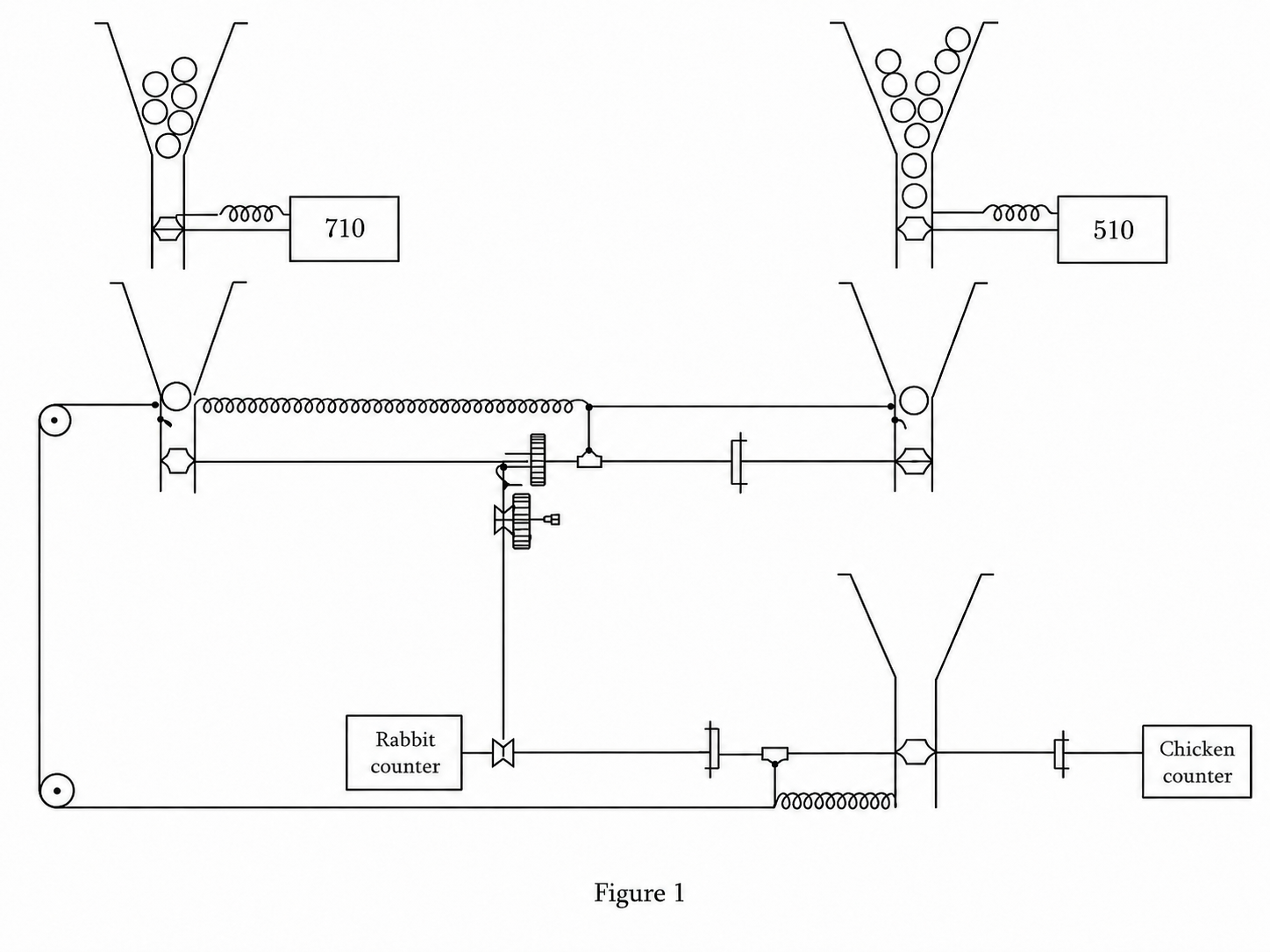
- When I was in primary school, there was an arithmetic problem considered difficult and solved only by good students. Chickens and rabbits are mixed together in a coop. There are 510 heads and 1,420 legs, and the question is how many of the animals are rabbits and how many are chickens.
The answer of a child who thinks through the problem goes like this. If we give two legs to each head, we will have placed 2 × 510 = 1,020 legs. We will then have 1,420 - 1,020 = 400 legs left. We can add these remaining legs, two at a time, to exactly 200 of the 510 heads to which we had already given two legs. Thus exactly 200 of the animals have four legs and are rabbits, while the remaining 310 have two legs and are chickens. A teacher would give a good grade to a student who answered this way, saying that the student reasoned correctly. Now let us build a machine that does the same job and therefore deserves the same good grade from the teacher.
In Figure 1, let the parts marked A and B be funnel-shaped containers, and let the circles inside them be balls. Let the balls in A represent heads and those in B represent pairs of legs. Let us place a turnstile at the mouth of each funnel and connect the shafts of the turnstiles to counters like those in taximeters. In these counters, let there be an arrangement similar to that of alarm clocks, so that when a number we have set is reached, a latch falls and locks the turnstile. If we set the counter in A to 510 and the one in B to 710, the turnstile in A will close after passing 510 heads, and the one in B after passing 710 pairs, that is, 1,420 legs. In this way we will have told the machine that the problem it is to solve contains 510 heads and 710 pairs of legs.
Now let 510 balls from A and 710 balls from B pass into the A′ and B′ funnels below them. Let us connect the turnstiles in A and B to those in A′ and B′ so that when the turnstiles in A and B lock, those in A′ and B′ open. In this way, after receiving the information given to it, the machine will say to itself, "now let us think."
When there is a ball on the turnstile of the A′ funnel, let the shafts of the A′ and B′ turnstiles mesh with one another as shown in the figure. Otherwise let the shafts separate. Let a gear on the shaft of the B′ funnel engage with the gear of a counter that we shall call the rabbit counter.
Now let us come to the turnstile of the A″ funnel below A′. Let this turnstile remain locked as long as there is a ball in the A′ funnel. Let its shaft remain engaged with the rabbit counter as long as there is a ball in the B′ funnel. When no balls remain in B′, let it engage instead with the shaft of the counter that we shall call the chicken counter.
Now let us see what the machine will do from the moment it says to itself, "let us think." From that moment on, balls will begin to fall two at a time from the A′ and B′ funnels, and this will continue until A′ is empty. In other words, the machine will give one pair of legs to each head. From the moment A′ becomes empty and 200 balls remain in B′, the turnstile of A″ will open, the rabbit counter will begin to operate, and the 200 balls remaining in B′ will begin to fall together, two at a time, with 200 of the 510 balls in A″. In other words, by giving these 200 extra pairs of legs to 200 of the heads to which it had already given one pair of legs, the machine will conclude that there are 200 rabbits. From the moment B′ becomes empty, the turnstile of A″ will engage with the chicken counter, and the machine will count the remaining 310 balls as chickens.
- Now let us turn to the machine that solves the following inheritance problem:
Let Douglas Macdonald have two sons named Angus and Brian, and let him leave instructions that his estate be divided as follows:
| Situation | Decision |
|---|---|
| One son is alive and the other is dead | The entire estate goes to the survivor |
| Both are dead | The entire estate goes to the Gaelic Home for the Aged and Indigent |
| Both are alive, and their marital and university-graduate status is the same | The estate is divided equally between them |
| Both are alive, but their marital and university-graduate status differs | The share of the Edinburgh University graduate increases by 20%, and the other's decreases by 20%. The share of the married son increases by 10%, and the other's decreases by 10%. |
The person carrying out the will must make the decision according to whether the answers to the following six questions are Yes or No:
| Question | Value | |
|---|---|---|
| 1 | Is Angus alive? | 0.50 |
| 2 | Is Brian alive? | 0.50 |
| 3 | Is Angus a graduate of Edinburgh University? | 0.20 |
| 4 | Is Brian a graduate of Edinburgh University? | 0.20 |
| 5 | Is Angus married? | 0.10 |
| 6 | Is Brian married? | 0.10 |
If the answer to either or both of the first two questions is No, the decisions required by the will are clearly as follows:
| Situation | Decision |
|---|---|
| Both answers are No | The estate goes to the Gaelic Home for the Aged and Indigent |
| Only the first answer is No | The estate goes to Brian |
| Only the second answer is No | The estate goes to Angus |
If the answers to the first and second questions are both Yes, the situation is somewhat more complicated. First, the other four questions must be asked. To decide according to the answers, the following rule in the will must be applied. If the answer to a question is Yes, the number beside that question is added to the share of the person named in the question and subtracted from the other's share. For example, if 3 is Yes, 4 is No, 5 is No, and 6 is Yes, the decision will be:
| Answers | Angus's share | Brian's share |
|---|---|---|
| 3. Yes | +20% | -20% |
| 4. No | ||
| 5. No | ||
| 6. Yes | -10% | +10% |
| +50% | +50% | |
| Result | 60% | 40% |
Of course, in making this calculation it is enough to calculate only Angus's share and take Brian's share as the amount needed to complete Angus's to 100%. The values of the questions in terms of Angus's share are therefore:
| Value of 3 | +20% |
| Value of 4 | -20% |
| Value of 5 | +10% |
| Value of 6 | -10% |
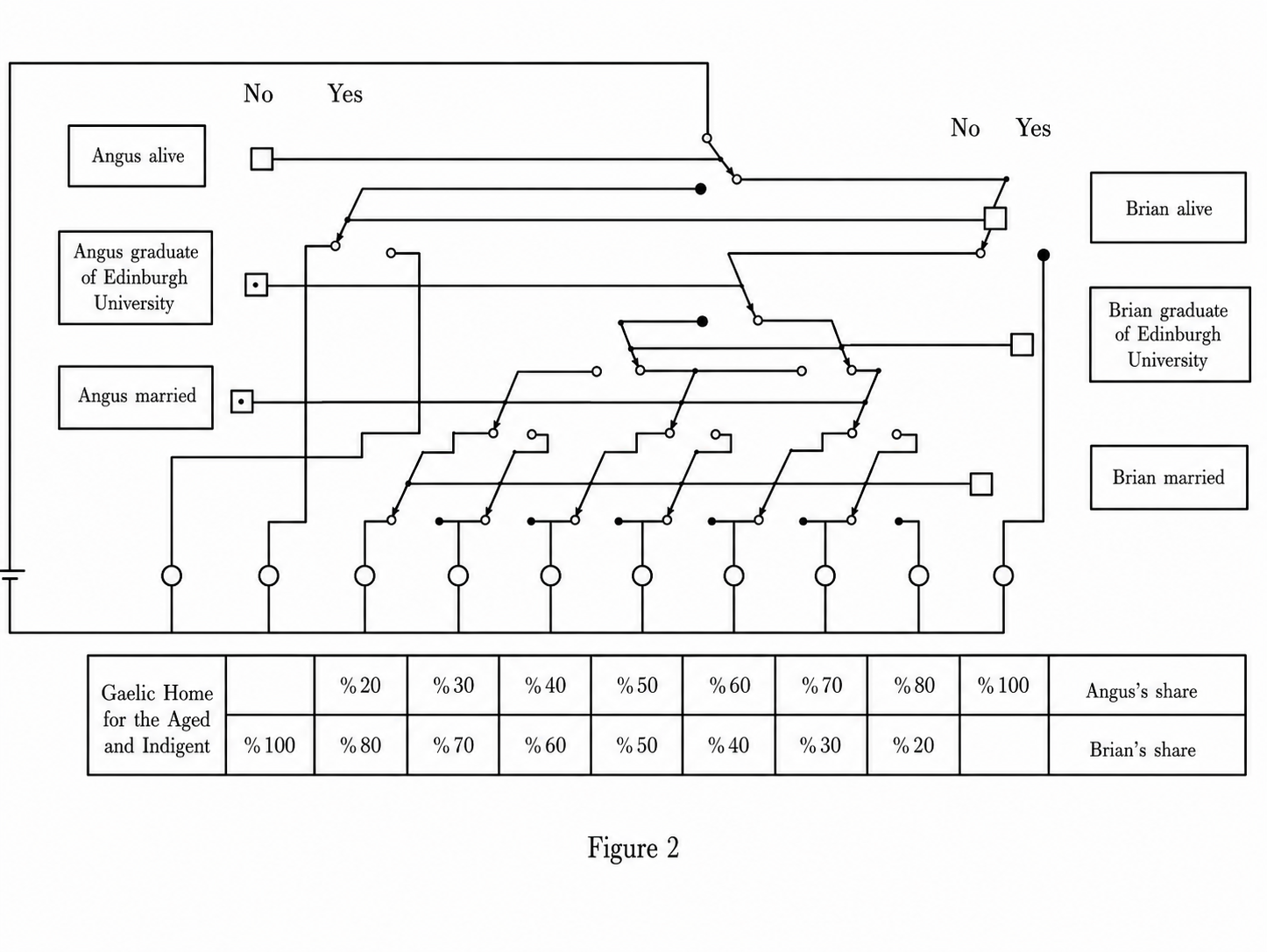
Accordingly, with a few lamps and a battery, we can build a device that gives the same answers under the same conditions according to the diagram in Figure 2.
This example is taken from an American toy called Geniac.
Editor's note: The original example appears as "The Machine for Douglas Macdonald's Will" in Edmund C. Berkeley's Geniacs: Simple Electric Brain Machines, and How to Make Them (1956 manual). Arf localized the names and institutions for his Turkish audience.
In this device, the questions are answered by moving the small squares beside them to the Yes or No positions. The device announces its decision by lighting one of its ten lamps. The translation of the decision from the machine's language into ours is written beneath whichever lamp lights up.
I imagine that these two examples I have given, showing that even very simple machines can reason, have not entirely satisfied you. Before examining why, let us note that despite their simplicity, these two examples provide good examples of two basic ways in which our brain works.
In the first, we construct in our imagination analogues of the connections between the information received and the result we want to derive from it, and the result is the result in our imagination. In this case, the machine scheme we have given is a material realization of this analogy. We shall call this kind of thinking "thinking by analogy," and machines that think in this way are, in the established terminology, called "analog machines."
In the second case, all possible results are considered, the lamps in Figure 2 or, in our language, the distributions of the estate written beneath those lamps, and the results that do not fit the information given are eliminated one by one by moving the square switches under Yes or No. Finally, the result that remains is the decision to be taken, the lamp that lights on the machine. This kind of reasoning is called "reasoning by elimination," and machines that work in this way are, in the established terminology, called "digital machines."
Now let us ask why, perhaps unfairly, you did not find these two examples satisfactory, and what conditions machines that we would regard as more satisfactory in this respect must meet.
The obvious defect in both examples is that each can solve only one problem, and in fact merely repeats, whenever asked, the solution of a problem that we ourselves have already solved. In addition, although the machine in the first example works incomparably more slowly than our brain, the second does not have this defect. Once it has received the necessary information, it gives the result more quickly than our brain and almost instantly.
Let us also note that even if we increased the number of problems a machine could answer from one to, say, ten thousand, we would still not regard it as a kind of artificial brain if, like the machines above, it solved only problems that we ourselves had solved when building it. We would then say that our brain solves problems it has never encountered before, or at least that it seems to us to do so, whereas there is nothing like this in the machine.
I think the characteristic property of the human brain is its ability to adapt to new situations, or more precisely to situations we think are new. What we now want to understand is therefore this: Can a machine capable of adapting, that is, one able to solve problems not considered when it was built, be built, and how can it be built?
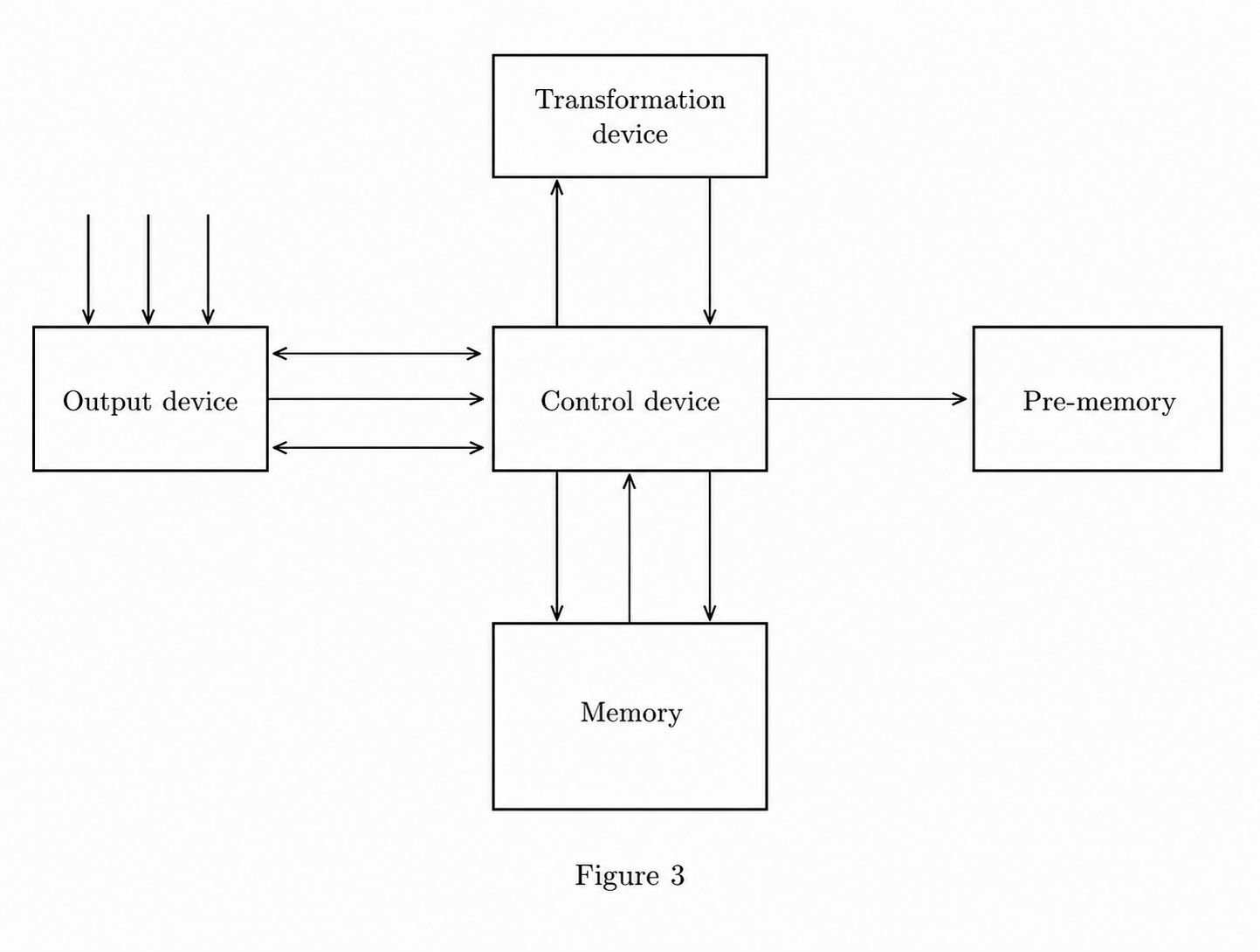
To examine this question, let us take a brief look at how our brain works:
A) First, a question is identified. This is a kind of recording of certain external inputs, such as words or observations. Let us assume that this recording takes place in a particular part of the brain. Even if no such place actually exists, that is of no importance here.
B) These inputs, recorded in the pre-memory,2 activate a kind of sorting area, in other words a control center. The control center sends to the pre-memory copies of the information related to these inputs from what we call memory, a kind of store of knowledge. Among the information sent from memory to the pre-memory there may sometimes be things such as: ask so-and-so, or look in such-and-such a book. In this way, other people or books become helpers to our memory and form a part of our brain outside the brain itself. Let us call this external part auxiliary memory.
C) The information collected in the pre-memory is directed by the control center to selected parts of a device that derives new information from the information given, either by logical calculation or by analogy. There it undergoes a kind of transformation. The result of this transformation is the brain's answer to the question.
D) The answer passes through the control center again and is sent outward through one of our output organs, while at the same time being recorded in memory.
In reality, the way the brain works may be much, much more complicated than this rough scheme. Nevertheless, we can accept that our brain sometimes works in this way. A machine that we would want to resemble our brain should therefore contain the parts shown in Figure 3 and the connections between these parts shown by the arrows in the figure.
Such a machine will naturally be able to receive and record only certain kinds of input, transform them, send them out, and record them in its memory. Let us call all the inputs it can receive and work on its input language, and what appears at its output device its output language.
The input language of our brain consists of words, and words consist of letters. The inputs that our brain can receive and transform therefore consist of sequences formed from the 29 letters of the Turkish alphabet, together with spaces. For example, the sentence "I will go outside, but the weather is cloudy" is such an input. The brain combines this input with the information in its memory and transforms it into: "I should take an umbrella."
Here we see that the reason our brain can continually solve new problems is that it can accept, that is, understand, a very large number of arrangements of the 29 letters as inputs and transform them according to the rules of logic with the help of other information, that is, other inputs, in its memory.
Let me also remind you that the richness of our language has nothing to do with the number of letters. If we used only two symbols, we could still obtain an equally rich language. Suppose, for example, that we used the symbols 0 and 1 as our letters. In place of the letters of the alphabet, let us use:
| Letter | Code | Letter | Code | Letter | Code |
|---|---|---|---|---|---|
| A | 00000 | B | 00001 | C | 00010 |
| D | 00011 | E | 00100 | F | 00101 |
| G | 00110 | H | 00111 | İ | 01000 |
| J | 01001 | K | 01010 | L | 01011 |
| M | 01100 | N | 01101 | O | 01110 |
| P | 01111 | R | 10000 | S | 10001 |
| T | 10010 | U | 10011 | V | 10100 |
| Y | 10101 | Z | 10110 | Ö | 10111 |
| Ü | 11000 | I | 11001 | Ğ | 11010 |
| Ç | 11011 | Ş | 111003 |
By putting these symbols in place of the letters, we can write every word with 0s and 1s. A machine capable of accepting all sequences of 0s and 1s as inputs, and transforming those inputs according to rules resembling the rules of logic, would have a language at least as rich as ours.
In reality, such a machine could not receive every possible sequence of 0s and 1s as a distinct input. If the number of 0s and 1s in a sequence were too large for the size of the machine, it would not be able to receive that sequence, or more precisely, would receive it incompletely. But is the human brain not the same? I know no one who could understand a sentence two thousand words long.
Now let us try to understand the very simple principles behind the construction of the machines that are currently being built and used under the name electronic brains and whose languages likewise consist of sequences of 0s and 1s.
An electric switch, as we all know, has two states. It either allows current to pass or it does not. We can regard the state in which it allows current to pass as 1, and the state in which it does not as 0.
If, then, the part of the machine we call the pre-memory contains more than one hundred electric circuits, and one hundred of them are connected to one hundred switches on the machine, by setting these one hundred switches, we can say a word or sentence of one hundred symbols to the machine. The machine has then recorded and understood it.
The next step is for the machine, under the influence of the symbols it has received, to send some of the information, that is, some of the sentences in what we call memory, to the pre-memory. First, let us get an idea of the part we call memory.
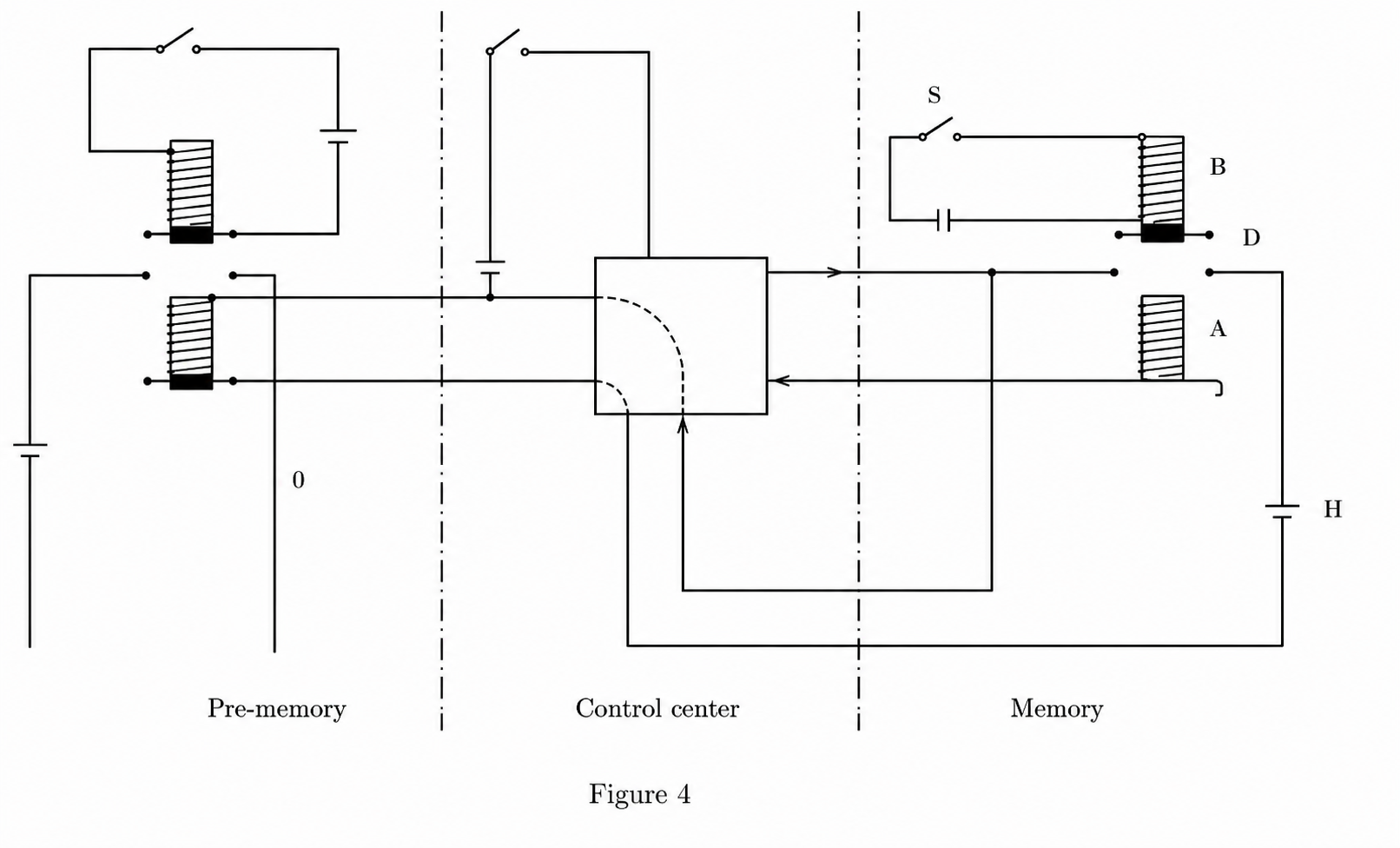
As we all know, if a wire is wound around an iron rod and an electric current is passed through it, the rod becomes magnetized and attracts pieces of iron. Now let us consider the electric circuit shown in Figure 4.
In the region marked memory in Figure 4, the parts marked A and B consist of two iron rods with wire wound around them. Between these two iron rods is the part marked D, an iron piece with a small copper plate attached to each side. This iron piece can move freely back and forth between A and B. When the iron piece D is attached to B, the electric circuit marked H is at 0. When D is attached to A, the H circuit is at 1.
The wire wound around rod A is connected to the control center, and depending on whether the control center sends current through this wire, the iron piece D either comes to A or remains at B. Even after the current from the control center is cut off, D does not change position. In this way one of the symbols 0 or 1 has been recorded in the H circuit and remains stored there.
The device we have just described is called a relay, and the H circuit is called a memory element. Let us suppose that the device we call memory consists of thousands of H circuits arranged in this way. The memory will then be able to store information consisting of thousands of 0s and 1s.
If the circuits wound around the B rods of all the memory elements are controlled by a switch S, pressing S makes the memory forget all its information and sets all the memory elements to zero.
As shown in the figure, the ends of the H circuit lead to the control device. There, through a number of relays, the H circuit either sends current or does not send current to a new relay in the pre-memory, depending on how the information in H relates to the question in the pre-memory. In this way, copies of the information in memory that is relevant to the question are brought into the pre-memory.
The circuits corresponding to the complete sequence of symbols collected in the pre-memory then pass through the control device to the logical calculation device. There, again by means of relays, they open or close a new set of circuits. The circuits opened or closed in this way form the question in its transformed state according to the rules of logic, that is, the machine's answer to the question.
The machine's output organ translates this answer into our language, for example according to the alphabet given above, and prints it on a typewriter.
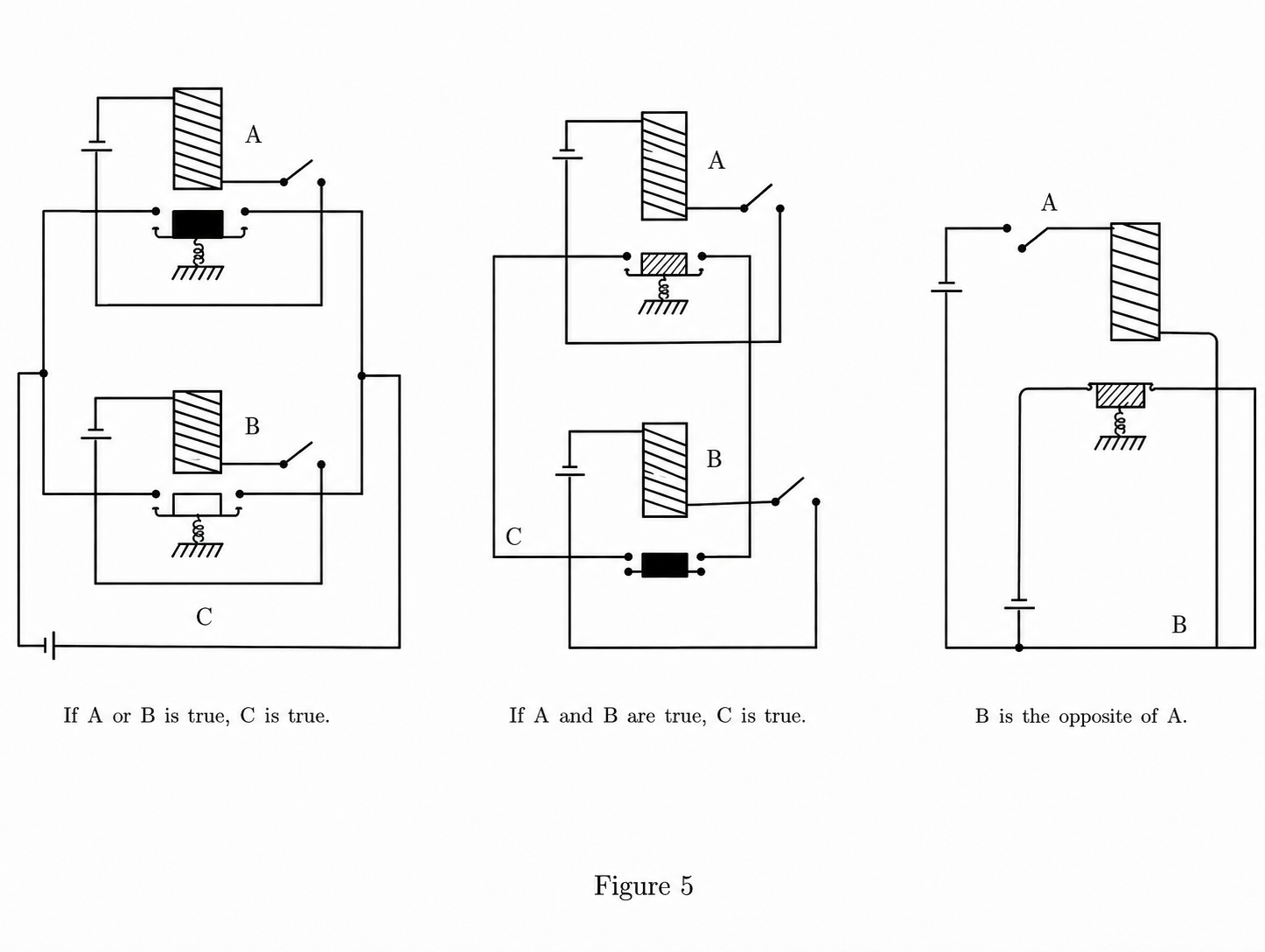
To show that the logical calculation device can in fact transform the symbols it receives according to the rules of logic, it is enough to show that the following three logical operations can be carried out with relays:
If A or B is true, C is true.
If A and B are true, C is true.
A is the opposite of B; so, if A is true, B is false, and if A is false, B is true.
In Figure 5, the statements A, B, and C are represented by electric circuits. Let a closed circuit indicate that the corresponding statement is true and an open circuit that it is false. It is then easy to see that the three diagrams in Figure 5 represent the three logical operations given above.
Among the thinking machines whose principles we have now described, those that perform very complex calculations and solve mathematical problems are built and used by research institutions for their own specialized work, and are also built and rented commercially by IBM, which has a representative in Turkey. In these machines, magnetic relays are replaced by circuits containing electronic tubes (the tubes used in radios), together with wire-like components of the kind used in radio receivers, allowing the machine to perform some tasks much faster than the human brain.
It can be seen that no diabolical intelligence is needed to understand these machines, one of the wonders of our time. Common sense is enough. But, as I said at the beginning of this talk, here as in every undertaking, designing and building the machine in all its detail requires endless patience and persistence, and a great deal of sweat. How fortunate are those who know the happiness of sweating over such work.
Let me end my remarks with a brief comparison of these machines with the human brain:
Although machines can perform some tasks much faster than the human brain, their capacity for understanding, that is, for receiving input, is far less varied than that of the human brain, even in machines large enough to fill a great hall. The human brain can develop itself on its own initiative, while a machine remains as it was built. It is nevertheless possible to design a machine that develops itself.
But in my view, the main difference between the human brain and the machine is that the human brain can receive inputs of an aesthetic nature and work on them, can make decisions that are themselves aesthetic in nature, and can feel free to do or not do a given task, whereas the machine has no equivalents of these qualities.
What characterizes all these qualities is that they contain an element of uncertainty and that there are no rules they invariably obey. There are also non-human natural phenomena with this same character of uncertainty. These are events that occur within the atom.
If events occurring within a relatively small number of atoms could be made to affect the operation of such machines, one might hope that machines could also be made to resemble the human brain aesthetically.
Such a machine might, for example, say that it does not find a certain piece of music beautiful. But I think this will not be possible even many centuries from now, and perhaps never.
Figures
Editor's note: The figures have been redrawn for legibility while preserving the structure of the 1959 originals. In Figure 4, the S label has been added for the switch explicitly described in the text. In Figure 5, B has been added as the output label in the third circuit to make the relationship shown by the circuit explicit.
Footnotes
-
Ether: A hypothetical medium once thought to fill space and carry light waves. ↩
-
Pre-memory: Arf's term for the area where the current input and relevant information retrieved from memory are brought together before processing. ↩
-
Editor's note: In the 1959 printing, both Ç and Ş are assigned
11011. The sequence shows that Ş should be11100. The printing error has been corrected here. ↩
Source
Arf, C. (1959). Makine Düşünebilir Mi ve Nasıl Düşünebilir? [Can a Machine Think and How Can It Think?]. Atatürk University, 1958–1959 Academic Year, Public Lectures I, University Extension and Public Education Publications, Conference Series No. 1, Erzurum, pp. 91–103.
Digitized from the archive of Dr. Emir Öngüner.